ENTERPRISE TECHNOLOGY | AI STRATEGY | PC REFRESH
If your IT organization is still approaching PC refresh as a routine, budget-driven cycle, the context has fundamentally changed. Generative AI is redefining what enterprise hardware must deliver. The question is no longer “Is this device still functional?” but “Is this device capable of supporting the next generation of AI-driven workflows?”
For IT leaders and procurement teams across India, this shift introduces both urgency and strategic opportunity. Organizations that proactively realign their hardware strategy will unlock disproportionate productivity gains.
The AI Hardware Inflection Point: What’s Driving the Shift
Enterprise adoption of AI is rapidly increasing demand for advanced compute infrastructure.
Constraints such as GPU shortages, rising DDR5 memory costs, and growing edge compute
requirements are no longer abstract trends—they are directly impacting procurement decisions.
Modern AI workloads ranging from real-time analytics to generative applications and intelligent automation require:
1. High-performance GPUs and NPUs to enable efficient on-device AI inference
2. DDR5 memory architectures to support parallel data processing at scale
3. Edge computing capabilities to reduce latency and dependency on centralized cloud
infrastructure
4. Processors capable of handling AI workloads alongside standard productivity tasks without compromising thermal efficiency or battery life
Encouragingly, a new generation of processors including Intel Core Ultra and AMD Ryzen AI is
designed to meet these requirements. These platforms enable local AI execution, reducing
latency, lowering cloud costs, and improving energy efficiency fundamentally reshaping the ROI
equation for hardware refresh decisions.
Windows 11: From OS Upgrade to AI Infrastructure Layer
Microsoft’s end-of-support timeline for Windows 10 is a fixed milestone. However, treating the
transition to Windows 11 as a compliance exercise significantly understates its strategic
importance.
Windows 11 is optimized for AI-capable hardware. While it can run on legacy systems,
performance limitations become immediately evident. On modern, NPU-enabled devices, the
experience is materially different:
1. Microsoft Copilot delivers meaningful productivity gains rather than limited
responsiveness
2. Security architecture aligns with zero-trust enterprise frameworks
3. AI-augmented collaboration tools enhance distributed and hybrid team productivity
4. Dynamic power and performance management adapts to real-time workload demands
For enterprise IT, migrating to Windows 11 on AI-capable hardware is not simply an upgrade—
it is a foundational step toward enabling an AI-driven workplace.
The India Opportunity: Timing as a Competitive Advantage
India’s digital economy is scaling rapidly, often outpacing enterprise hardware refresh cycles. AI
adoption, cloud collaboration, and data-intensive workflows are placing increasing strain on
legacy systems still widely in use.
Organizations that are refreshing proactively are already realizing measurable benefits:
1. Developers and data scientists leveraging on-device AI inference to reduce reliance on cloud queues
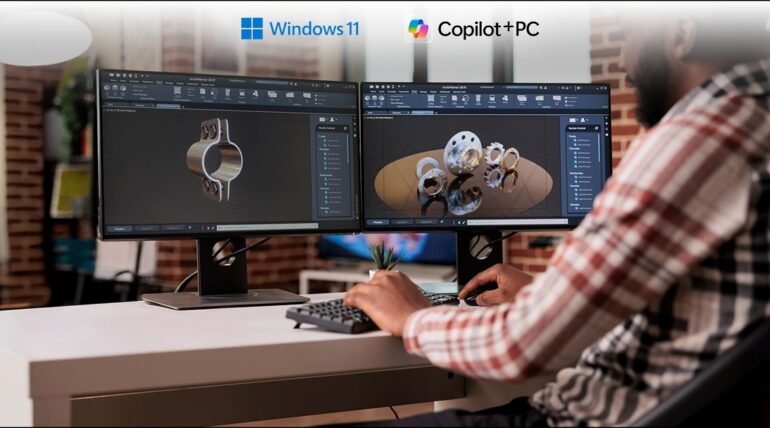
2. Creative and design teams executing high-performance workloads on mobile
workstations without requiring fixed desktop environments
3. Analysts processing larger datasets using AI-augmented tools enabled by NPU
acceleration
4. Leadership teams collaborating across geographies using AI-enhanced communication
and documentation tools
The strategic question is no longer whether to refresh, but whether to do so proactively or
reactively. Delayed refresh cycles risk compounding productivity losses over time.
What a Strategic Refresh Model Looks Like
A blanket upgrade across all roles is neither necessary nor efficient. A role-based refresh strategy enables targeted investment with faster returns:
1. Prioritize high-impact roles (developers, analysts, designers, data scientists) where AI capabilities deliver immediate productivity gains
2. Deploy mobile workstations across engineering and creative teams to enable performance
without location constraints
3. Standardize on Windows 11 and AI-capable hardware as the baseline for all future
procurement
4. Evaluate total cost of ownership holistically, factoring in reduced cloud compute costs, lower IT overhead, and increased workforce productivity
Leading OEMs including Dell, Lenovo, and HP have expanded their AI PC portfolios, providing flexibility in performance, form factor, and pricing across enterprise use cases.
Emerging Category: Personal AI Supercomputers
A new class of “Personal AI Supercomputers” is beginning to reshape enterprise hardware
strategy. Built on NVIDIA’s Grace Blackwell (GB10) architecture, these systems integrate CPU and GPU into a unified AI-native platform, enabling organizations to run advanced AI workloads
locally with lower latency, reduced cloud dependency, and enhanced data control.
OEMs such as Lenovo (ThinkStation PGX SFF), Dell (Pro Max), HP (ZGX Nano), and NVIDIA (DGX Spark) are introducing these platforms to market, signaling a structural shift beyond
traditional CPU-GPU architectures toward AI-first infrastructure. While adoption remains early,
forward-looking organizations should incorporate this category into long-term refresh and
workforce productivity planning.
Key Takeaways
1. AI adoption is elevating hardware requirements beyond the capabilities of legacy systems
2. NPU-enabled processors (Intel Core Ultra, AMD Ryzen AI) enable efficient on-device
AI execution
3. Windows 11 unlocks AI-driven productivity features that require modern hardware to perform effectively
4. A phased, role-based refresh strategy maximizes ROI while minimizing disruption
5. Early adopters are building a sustainable competitive advantage through improved
workforce productivity
AI Readiness Is Now a Strategic Procurement Decision
PC refresh decisions have historically focused on cost and performance. AI introduces a third dimension: competitive readiness. Organizations operating on outdated hardware are not only
constrained by performance they are limited in their ability to adopt the tools reshaping modern
work.
Aligning AI-capable devices with Windows 11 and intelligent productivity platforms is no
longer a future consideration. It is a present-day decision with immediate and compounding
returns.
For organizations planning their next refresh cycle, the priority should be clear: move beyond
specifications and invest in infrastructure that aligns with how work is evolving.