The New Reality for GCCs: From Pilots to Production AI
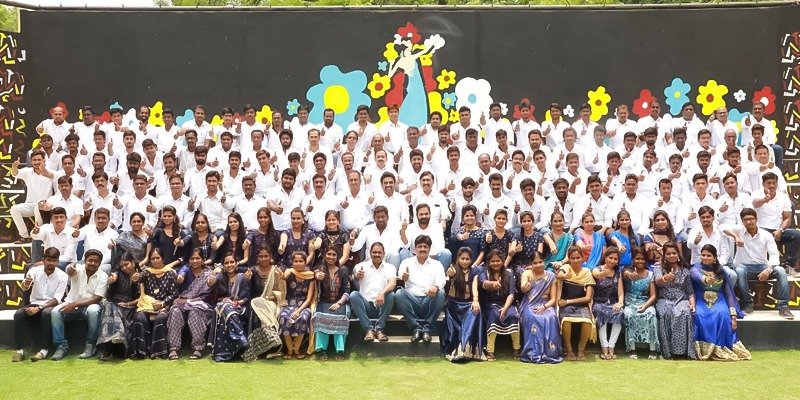
Global Capability Centers (GCCs) are being asked to move beyond proof-of-concepts and deliver production-grade AI that is governed, secure, and scaled across business lines. Recent industry research shows that only a small minority of GCCs have reached advanced AI maturity.¹ Yet the clear differentiator for leaders is deeper AI adoption across workflows and strong platform choices that compress time-to-value.
GCCs in India are rapidly becoming enterprise AI hubs, with AI roles exceeding 126,000. The Bengaluru–Hyderabad–Chennai triangle now forms the core talent ecosystem powering large-scale LLM initiatives.²˒³
GB10-Powered Workstations
While data center racks handle training at scale, GCCs also need developer-friendly systems for critical day-to-day work including:
● Teams need these systems for data preparation and curation to ensure high-quality training datasets.
● RAG pipeline development requires accessible compute resources for rapid iteration and testing.
● Model fine-tuning demands systems that can handle parameter updates without overwhelming shared infrastructure.
● Synthetic data generation workloads benefit from dedicated resources that don’t compete with production jobs.
● L4/L5 inference experiments require immediate access to test models before deployment.
Ideally, teams need to accomplish these tasks without constantly booking data center time or waiting in job queues.
Source: NVIDIA
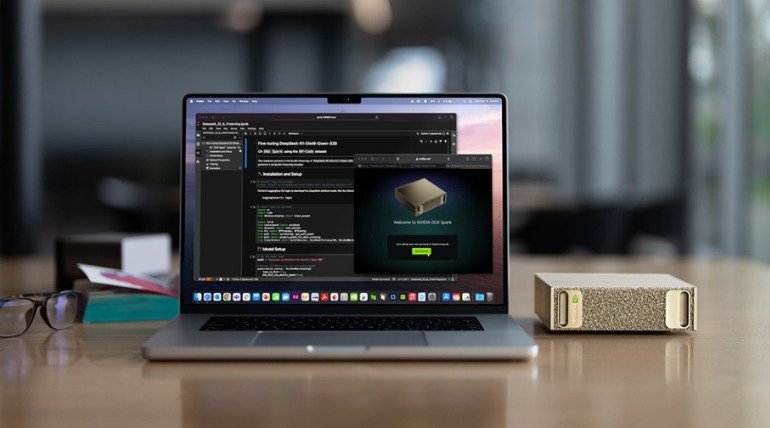
Introducing the NVIDIA DGX Spark and GB10-Powered Workstations
The NVIDIA DGX Spark, formerly known as “Project Digits,” is powered by the GB10 Grace-Blackwell Superchip and represents a new category of deskside AI development systems.⁴ The system delivers up to approximately 1 PFLOP of FP4 AI compute performance. It features 128 GB of unified memory, which enables local work with models up to approximately 200 billion parameters. The DGX Spark includes ConnectX networking that allows users to cluster two units together for even larger contexts.⁴
The system ships with the complete NVIDIA AI software stack including CUDA-X libraries, NIM microservices, and DGX OS. This comprehensive software stack enables developers to prototype and fine-tune models on the device, then promote their work to the cluster unchanged.⁴ Independent coverage highlights the Spark’s role as a capable, Linux-first, CUDA ecosystem “toolbox” for AI development.⁵
What are the OEM Alternatives to NVIDIA’s DGX Spark?
Leading OEMs are launching their own GB10 desktop systems with the DGX stack for deskside AI development:
● Dell offers the Pro Max GB10, which provides enterprise-grade GB10 computing in a workstation form factor.
● HP provides the ZGX Nano AI Station G1n, designed for professional AI development workflows.
Conquer Technologies can help customers integrate any OEM solution into their enterprise environment seamlessly in partnership with the OEM of choice.
Why GB10 Workstations Deliver Better TCO for Dev/Test vs.
Full HPC Nodes
For iterative workloads including fine-tuning, prompt engineering, evaluation harnesses, agent simulations, and data curation, GB10 systems offer significant advantages.
Reduced Operational Friction
● GB10 systems eliminate queueing delays, giving developers immediate access to compute resources without waiting for shared cluster availability.
● These workstations help teams avoid the complexity of scheduling shared HPC resources, which reduces data center overheads significantly.
● Developers can fail-fast locally, enabling rapid iteration cycles without impacting production infrastructure or consuming cluster credits on experimental work.
Preserved Performance Capabilities
CUDA, TensorRT-LLM, and NVLink-C2C advantages with GB10 workstations. When a job is “ready” for scale, it transitions to DGX racks with minimal rework because the software stack remains identical.⁴
Direct Business Impact
This developer-productivity advantage converts directly to measurable business outcomes:
● Teams achieve lower cost per feature by reducing the time spent waiting for compute resources.
● Organizations realize faster time-to-value as developers iterate more quickly on prototypes and experiments.
● Development teams demonstrate higher throughput when they have dedicated resources for experimentation.
NVIDIA positions the Spark precisely for this “develop here, scale there” workflow, enabling seamless transitions from desk to data center.⁴
Where to Use GB10 Devices?
Optimal GB10 Use Cases
● Local data wrangling and preparation tasks benefit from immediate access to GB10 compute without network latency or queue delays.
● Adapter-based fine-tuning workloads fit well within the 128 GB memory envelope while requiring iterative testing cycles.
● Evaluation loops and benchmarking experiments can run continuously on dedicated GB10 hardware without impacting shared resources.
● Rapid prototyping and experimentation workflows accelerate when developers have always-available compute at their desk.
When to Scale to DGX?
Reserve NVL72/8-GPU DGX systems for workloads that truly require massive scale:
● Large-batch pre-training operations that need hundreds of GPUs working in concert across multiple nodes.
● Reinforcement learning from human feedback (RLHF) pipelines that demand extensive parallel processing capabilities.
● Production-grade, ultra-low-latency inference deployments that serve high-volume user requests.⁴˒⁶
GB10 Workstation Features at a Glance
Compute Architecture
The NVIDIA GB10 Grace-Blackwell Superchip integrates CPU and GPU on one module, delivering up to approximately 1 PFLOP FP4 performance for AI tasks. This unified architecture eliminates traditional PCIe bottlenecks between processor and accelerator.
Memory Configuration
The system provides 128 GB of unified memory, which is critical for big-context LLM work at the desk. Users can cluster two units over ConnectX networking to raise parameter ceilings further and handle even larger model contexts.
Software Stack
The GB10 workstation ships with the complete NVIDIA AI stack including CUDA-X, NIM, and DGX OS. This software foundation enables a frictionless path from local prototype to DGX production deployment.⁴
TCO Advantages
Compared to booking time on HPC or GPU farm nodes for early development, GB10 units can lower total cost of ownership through several mechanisms:
● The systems require far less orchestration overhead for small, iterative jobs compared to scheduling and managing multi-node cluster resources.
● Development teams achieve higher utilization rates when they have dedicated GB10 resources instead of competing for shared cluster time.
● Organizations reduce data center energy and cooling costs for work that doesn’t require 8–72 GPUs yet remains compute-intensive.⁴
Why Partner with Conquer Technologies LLP for AI Infrastructure?
Conquer Technologies LLP partners with leading OEMs to deliver end-to-end AI infrastructure solutions. Our offerings span from deskside GB10 workstations and RTX PRO Blackwell developer rigs to rack-scale DGX GB200 NVL72 deployments. We help GCCs and enterprises move from first experiment to factory-scale AI quickly and safely.
Strategy & Workload Mapping
We benchmark your specific use cases including RAG, fine-tuning, MoE, vision, and agentic pipelines against platform choices such as GB10, DGX B200, and NVL72. Our analysis balances performance requirements, total cost of ownership, and energy consumption to recommend optimal configurations.⁶˒⁷
Reference Architectures & Sizing
We deliver NVIDIA-validated designs ranging from 8-GPU nodes to NVL72 racks with the right networking infrastructure. Our architectures incorporate InfiniBand or Spectrum-X networking, appropriate storage tiers, and both air and liquid cooling options based on your facility capabilities.⁶˒⁸
Facility Readiness & Deployment
Our team conducts power and cooling audits to ensure your facility can support AI infrastructure requirements. We handle manifold and CDU planning for liquid-cooled systems and execute rapid bring-up processes that shorten deployment timelines from months to weeks.⁹
Software Stack & MLOps
We roll out NVIDIA AI Enterprise, Base Command, and Run:ai for orchestration across your infrastructure. Our implementations include governance patterns specifically designed for multi-tenant GCC environments where multiple teams share resources.¹⁰˒⁶
FinOps & SustainOps
We model cost-per-token and energy consumption curves for GB10 versus DGX nodes versus NVL72 configurations. These analyses help you hit both ROI targets and sustainability goals, with particular attention to how liquid cooling often improves energy efficiency materially.¹¹
Lifecycle & Uptime
We implement integrated monitoring, failover capabilities, and predictive maintenance protocols aligned with DGX SuperPOD constant-uptime practices. These systems ensure your AI infrastructure remains available for critical development and production workloads.⁶
Final Thoughts
GCCs, hospitals, banks, and manufacturers can now access a compact yet industrial-strength AI platform that is deployable in standard racks or laboratory environments. These GB10-powered workstations accelerate both time-to-first-model and time-to-production while maintaining enterprise-grade reliability and security.⁴˒⁶
The platform provides a clear growth path for organizations at any stage of AI maturity. Teams can start with a GB10 desk unit for experimentation and validation, then scale seamlessly to DGX racks as needs grow and workloads mature. This approach reduces risk while accelerating learning and development cycles.
AI factories scale better when experimentation is decentralized and accessible to development teams. Conquer Technologies positions itself as an AI infrastructure advisor, helping enterprises move from desk-level experimentation to factory-scale AI deployments safely and efficiently.
Explore how a desk-to-cluster AI strategy can accelerate your AI roadmap. Contact Conquer Technologies today.
References
1. BCG. “Global Capability Centers AI Maturity Research.” bcg.com
2. Economic Times. “GCC Talent and AI Roles in India.” gcc.economictimes.com
3. Industry Reports. “India’s AI Talent Triangle: Bengaluru-Hyderabad-Chennai.”
4. NVIDIA. “DGX Spark (Project Digits) and GB10 Grace-Blackwell Superchip.” nvidia.com
5. Tom’s Hardware. “NVIDIA DGX Spark Coverage and Analysis.” tomshardware.com
6. Boston IT. “DGX Systems and AI Infrastructure Solutions.” boston-it.com
7. ASP Systems. “AI Workload Benchmarking and Platform Selection.” aspsys.com
8. HPE. “AI Infrastructure Reference Architectures.” hpe.com
9. NVIDIA Documentation. “DGX Deployment and Facility Planning.” docs.nvidia.com
10. Lenovo Press. “NVIDIA AI Enterprise and MLOps Solutions.” lenovopress.lenovo.com
11. Supermicro. “Energy Efficiency and Liquid Cooling for AI Infrastructure.” supermicro.com